

Washable Furniture Covers for Dogs: 2026 Buying Guide
Table of Contents
- What Washable Furniture Covers for Dogs Actually Need to Do
- Best Material for Dog Couch Covers: A Washable Fabric Comparison
- Waterproof Sofa Covers for Pets: Absorb, Block, or Both?
- Non-Slip Couch Covers for Dogs That Stay Where You Put Them
- Sizing and Fit: Two-Seat, Three-Seat, Sectional, and Recliner Covers
- Best Couch Covers for Dogs: How to Judge One Before You Buy
- Care and Laundering: Making Washable Covers Last
- Putting It All Together
- Frequently Asked Questions
Last Updated: October 9, 2026
What Washable Furniture Covers for Dogs Actually Need to Do
A washable furniture cover for dogs is a removable, machine-launderable protective layer that sits over upholstery to absorb accidents, trap fur and odor, and survive repeated washing without losing its backing or fit.
Below, we break down the four jobs a dog cover must handle, then compare the materials, waterproofing methods, and fit options that decide whether a cover lasts years or gets replaced by spring.
The Four Jobs Every Dog Cover Must Handle
Every cover has to do four things well, and most fail at least one.
- Absorb liquid on contact instead of letting it pool or run
- Block moisture from reaching the cushion underneath
- Lock in odor, especially urine, until you wash it out
A cover that absorbs but doesn't block soaks through. One that blocks but doesn't absorb leaves a puddle. The best couch covers for dogs handle all four at once, which is why material choice drives everything else.
Best Material for Dog Couch Covers: A Washable Fabric Comparison
The best material for dog couch covers balances absorbency, durability, and how easily it releases fur and odor in the wash. No single fabric wins on every measure, so the right pick depends on whether your dog sheds, drools, or has accidents, and how often you launder.
| Fabric | Fur Release | Absorbency | Breathability | Typical Dry Time (low heat) | Durability Over Repeated Washes | Comfort | Best For |
|---|---|---|---|---|---|---|---|
| Microfiber (tight weave) | Excellent | High | Low to medium | 45-75 min | High, resists pilling | Soft, slightly warm | Heavy shedders, daily wear |
| Cotton twill | Good | High | High | 60-90 min | Medium, can fade and thin | Cool, crisp | Households that wash weekly |
| Polyester blend | Good | Low | Low | 30-50 min | High, holds shape | Smooth, can feel slick | Water resistance, not absorption |
| Quilted layered (absorbent face + barrier) | Excellent | High | Medium | 75-120 min | High, layers stay bonded if washed cold | Plush, padded | Accidents plus shedding |
| Velvet or plush | Poor | Medium | Low | 90-120+ min | Medium, crushes and mats | Luxurious | Looks over function |
| Canvas or denim | Fair | Medium | Medium | 90-120 min | High, abrasion resistant | Sturdy, stiff | Diggers and chewers |
How Each Fabric Handles Fur, Mud, Drool, and Odor
Cotton twill absorbs drool and muddy paw moisture quickly and breathes well, so it feels cool under a dog.
Polyester blends resist water well but push liquid sideways rather than pull it in, so a spill can still reach the cushion.
Quilted layered covers combine an absorbent face with a moisture barrier underneath.
Velvet and plush photograph beautifully and hide nothing.
Matching Fabric to Your Dog and Your Laundry Habits
- Heavy shedder, low-maintenance household: microfiber or quilted layered, best fur release, tolerates infrequent washing.
- Drooler or puppy in training: quilted layered with a moisture barrier, absorbs on contact and blocks soak-through.
- Weekly washer who wants a cool surface: cotton twill, breathable and absorbent, accept the shorter lifespan.
Drying, Shrinkage, and Breathability Trade-offs
Drying time is the hidden cost of a washable cover. A quilted layered cover that takes two hours on low heat uses more energy and ties up the dryer than a polyester blend that finishes in under an hour.
Breathability cuts both ways: high-breathability fabrics like cotton keep a dog cool but let liquid pass through faster without a barrier layer, while low-breathability fabrics like microfiber and polyester trap warmth and can hold odor if stored damp.
Waterproof Sofa Covers for Pets: Absorb, Block, or Both?
Waterproof sofa covers for pets fall into two categories: those that block liquid and those that absorb it first, then block it. Only the second type prevents both puddles and soak-through.
Why Beading Water Is Not the Same as Locking It In
When liquid beads on a surface, it stays mobile. On a flat cushion, that bead spreads, finds a seam, and wicks through. This is why so many covers fail the exact moment they're needed.
Absorption-first construction works differently. Liquid hits the surface, gets pulled into the fabric immediately, and stays locked there until a wash cycle releases it. No pooling, no runoff, no seam creep.
American Kennel Club guidance on managing pet messes at home notes that odor problems usually come from moisture reaching the padding below the surface, not from the surface fabric itself. Our Pet Furniture Throws use a patented layered build that absorbs on contact and holds liquid and odor until laundering.
Non-Slip Couch Covers for Dogs That Stay Where You Put Them
Non-slip couch covers for dogs use a textured or gripped backing that creates friction against upholstery, so the cover resists sliding when a dog jumps up or digs in.
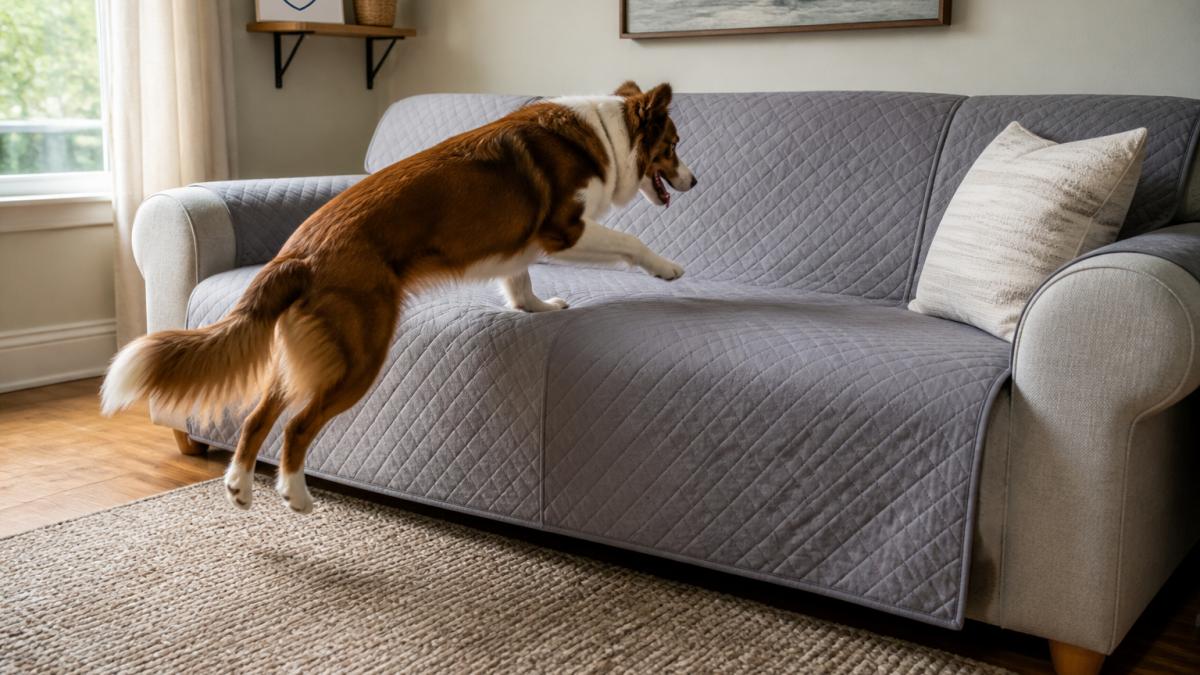
Three things determine whether a cover stays put:
- Backing grip. A rubberized or textured underside holds better than smooth lining.
- Tuckable excess. Extra fabric that tucks into cushion gaps anchors the cover.
- Stretch fit. Knit covers with elastic corners move with the furniture instead of against it.
Fit and grip work together: a gripped backing on an oversized cover still bunches, because the slack has nowhere to go. Measure first, then choose the backing.
Sizing and Fit: Two-Seat, Three-Seat, Sectional, and Recliner Covers
Sizing is where most returns happen. A cover sized for a two-seat couch won't stretch across a three-seat sofa, and a standard sofa cover won't accommodate an articulating recliner. Measure your furniture the way cover makers measure it, not the way you'd measure for a slipcover you never intend to remove.
Pet Furniture Throws & Covers →
How to Measure Your Sofa in Five Steps
Use a soft tape measure and record everything in inches, with the cushions in place, that's the shape the cover has to fit.
- Seat width (arm to arm, inside). Measure from the inside of one armrest to the inside of the other, across the front of the seat cushions. This is the number that decides two-seat versus three-seat sizing.
- Seat depth. Measure from the front edge of the seat cushion to the backrest. Deep seats (over 24 inches) need covers with extra tuckable fabric or a stretch panel.
- Back height. Measure from the top of the seat cushion to the top of the backrest. This determines whether a cover drapes fully or leaves the top of the back exposed.
- Arm height and width. Measure the outside of the arm from the floor to the top, and the arm's width front to back. If the cover wraps the arms, both numbers matter; if it tucks between the arm and cushion, only the height matters.
- Overall width and depth. Measure the full outside width and the full front-to-back depth. Compare this to the cover's stated range, most covers list a range, and you want your measurement near the middle, not the edge.
Write the numbers down and keep them. If you replace the sofa or add a sectional piece later, you'll want the same reference.
Two-Seat, Three-Seat, and Sectional Configurations
| Furniture Type | What to Measure | Fit Priority | Common Mistake |
|---|---|---|---|
| Two-seat couch (loveseat) | Inside seat width, back height | Snug stretch fit | Buying a three-seat cover and tucking the excess |
| Three-seat couch | Full width, arm shape, cushion gaps | Tuckable excess | Ignoring arm shape, rolled and square arms fit differently |
| Sectional (L-shape or U-shape) | Each section separately; note whether the corner is a wedge or a square | Per-piece coverage | Assuming one cover fits the whole sectional |
| Recliner or lift chair | Extended footrest length, arm travel, back height when reclined | Articulation-rated stretch | Measuring only in the upright position |
| Chaise or lounger | Full length including the chaise extension | Continuous coverage | Using a standard sofa cover that stops at the seat |
For sectionals, measure each section as its own couch and check whether the cover is sold as one piece or per-seat; a single-piece cover rarely fits a corner cleanly, while per-piece covers cost more but stay put. For recliners and lift chairs, measure with the footrest fully extended and the back reclined, a cover that fits a stationary couch will pull loose every time the footrest extends.
Furniture-Specific Fit: Leather, Delicate Upholstery, and Modular Pieces
Leather and faux leather. Smooth leather offers almost no friction, so a cover without a gripped backing slides constantly.
Delicate upholstery (linen, silk blends, velvet). These surfaces snag easily.
Recliners and lift chairs. The cover has to move with the mechanism.
Modular sectionals. If you can rearrange the pieces, buy per-seat covers so each module keeps its own fit.
Chaise lounges. The chaise extension is the failure point.
Why Fit and Grip Work Together
A gripped backing on an oversized cover still bunches, because the slack has nowhere to go. A perfectly sized cover with a smooth backing still slides on leather. Measure first, then choose the backing, and if you're between two sizes, size down for stretch covers and size up for tuckable covers.
Best Couch Covers for Dogs: How to Judge One Before You Buy
The best couch covers for dogs pass five checks: absorption, moisture blocking, odor control, grip, and wash durability. Skip any one and you'll be shopping again within a year.
A Short Evaluation Checklist
- Absorbs liquid on contact rather than beading it
- Blocks moisture from reaching the cushion
- Controls urine odor until washed, not just masks it
Care and Laundering: Making Washable Covers Last
Machine-washable covers last longest when you wash cold and dry low. Hot water and high heat break down backings and shrink stretch panels faster than anything else.
A practical routine:
- Shake off loose fur before washing so it doesn't clog the drum
- Wash cold on a gentle cycle with mild detergent
- Skip fabric softener, which coats fibers and reduces absorbency
Most quality covers handle repeated laundering without losing grip or absorbency. If a cover starts beading water after a few months, the finish has worn off, and it's time to replace it.
Putting It All Together
Choosing washable furniture covers for dogs comes down to four decisions: absorption over beading, a moisture barrier that actually holds, a non-slip backing matched to a correct fit, and a wash routine that preserves all three.
If you'd rather skip the trial and error, Magic Fabric™ builds covers around exactly these requirements. Our patented performance fabric absorbs liquid instantly and locks in odor until you wash it out, with a PFAS-free, skin-safe build and a 30-Day Leak-Proof Guarantee.
Frequently Asked Questions
What are the best washable couch covers for dogs?
The best options absorb liquid fast instead of letting it bead, lock in odor until you wash them, and hold their shape in a standard machine cycle. Look for a waterproof layer, a non-slip backing, and a fit that matches your sofa type. Magic Fabric's Pet Furniture Throws ($99) combine instant absorption, odor locking, and machine washing in cold water with tumble dry low.
What is the best material for couch covers for dogs?
No single fabric wins everywhere. Prioritize a fabric that is washable, breathable, and paired with a waterproof backing rather than a specific fiber name.
How do I keep a furniture cover from slipping when my dog gets on the couch?
A slip-resistant backing is the main fix, since it grips upholstery while your dog jumps up and settles. For extra hold, tuck the edges into the seat cushions or use the anchor straps many covers include. Fitted stretch covers stay put better than draped throws. If a cover still bunches, the size is likely wrong, so size down or switch to a fitted style.
How often should I wash furniture covers used by dogs?
Wash weekly if your dog sheds heavily, drools, or has accidents, and every two to three weeks for lighter use. Covers that lock odor inside the fabric can go longer between washes because smells do not escape until laundering. Always follow the care label: cold water and low tumble dry protect the waterproof layer and the non-slip backing.