

Best Furniture Covers for Recliners: 2026 Buyer's Guide
Table of Contents
- Quick Comparison: Best Furniture Covers for Recliners
- How to Choose the Right Size and Fit
- Waterproof Recliner Covers: What Actually Stops Leaks
- How to Install Recliner Slipcovers Without the Struggle
- Recliner Covers for Elderly Mobility and Lift Chairs
- Materials, Maintenance, and Long-Term Durability
- Conclusion
- Frequently Asked Questions
Last Updated: September 20, 2026
Quick Comparison: Best Furniture Covers for Recliners
Finding the best furniture covers for recliners comes down to four things: waterproof protection, a non-slip fit, odor control, and washability. Magic Fabric™ builds its entire line around those four priorities. This guide from Magic Fabric™ walks through sizing, installation, materials, and the maintenance details most buyers only discover after a cover fails.
Recliners take more abuse than any other seat in the house.
How to Choose the Right Size and Fit
Measure before you buy. Almost every recliner cover complaint traces back to a guessed size rather than a measured one.
Measuring Seat Width and Depth
Run a tape measure across the seat from armrest to armrest for seat width, then from the front edge to the backrest for depth. Write both numbers down and compare them against the cover's stated dimensions. A snug fit depends on matching those two figures, not on the recliner's marketing label.
Matching Covers to Reclining Mechanisms
This is where most buyers get burned. A cover that fits a fixed armchair will not survive a reclining mechanism that raises a footrest and tilts the back.
Check three points before ordering:
- Where the footrest hinge sits when fully extended
- Whether the backrest reclines independently of the seat
- How much fabric the mechanism pulls when it moves
Waterproof Recliner Covers: What Actually Stops Leaks
Waterproof recliner covers fail for one reason: they bead liquid instead of absorbing it. A surface coating pushes spills toward the edges, where they roll off onto the cushion.
How to Install Recliner Slipcovers Without the Struggle
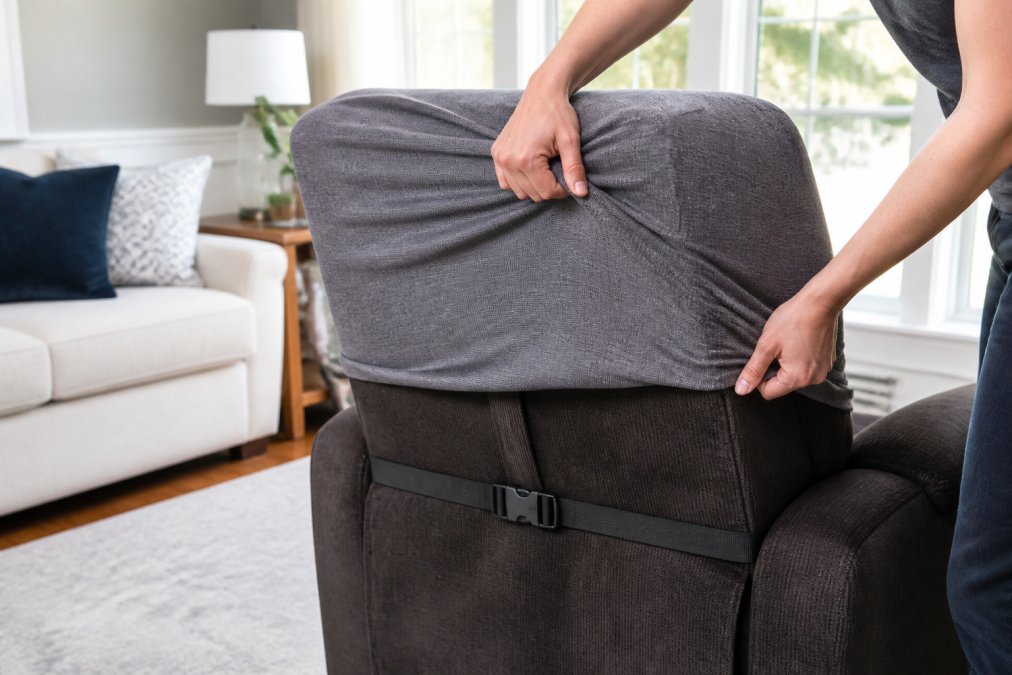
Installing recliner slipcovers takes about ten minutes per chair when you work in the right order. Rushing the sequence is what turns a simple job into a wrestling match, and the sequence changes depending on which mechanism is bolted under the seat.
Match the Install Order to the Mechanism
Most guides give one set of steps and ignore that a wall-hugger, a rocker recliner, and a lift chair move in completely different ways. Get this wrong and the cover will fight you every time the chair moves.
- Wall-hugger (push-back) recliners: The back slides down and forward rather than tilting back, so the chair can sit inches from the wall. Install with the chair fully reclined, then anchor the back panel low, the fabric needs slack at the top of the backrest, not the bottom, because the back travels downward.
- Rocker recliners: The whole chair pivots on a base rail. Any strap that crosses under the seat frame can snag the rocker mechanism or the spring deck. Route elastic straps front-to-back along the seat rails and keep them clear of the pivot point.
- Lift chairs: The seat tilts forward and up to help someone stand. A cover that only hooks under the seat will slide off during the lift cycle. Look for a pad or cover with a strap that also anchors around the backrest or over the armrests.
- Handle or remote side: Whichever side has the lever, pull cord, or hand control, leave that armrest panel slightly looser so the fabric does not bind the lever travel.
Step-by-Step Install
- Recline the chair fully so the footrest hinge and back mechanism are extended and accessible.
- Drape the cover over the backrest first, centering the seam on the headrest.
- Pull the front panel down over the seat and tuck it into the gap behind the footrest.
- Hook the elastic straps underneath the seat frame, front to back, not side to side, which pulls the cover off-center when the chair reclines.
- Roll the armrest covers into place and smooth the fabric toward the seams.
- Return the chair to upright, then run it through one full recline-and-close cycle before you call it done.
Troubleshooting the Three Most Common Fit Failures
- Cover pops loose when you recline. The straps are too loose, or you used a stiff tailored cover on a moving mechanism. Tighten the straps first; if it still slips, the fabric has no stretch and will keep slipping.
- Fabric bunches at the footrest hinge. The front panel is tucked too deep. Pull it back an inch so the hinge has room to fold without pinching fabric into the mechanism.
- Cover slides sideways on a rocker. A strap is crossing the rocker rail. Re-route it along the seat frame instead.
If the cover shifts when you recline, fix it before the first real use, a cover that moves once will keep moving, and repeated tugging stretches the seams until they tear.
Recliner Covers for Elderly Mobility and Lift Chairs
Recliner covers for elderly mobility have to solve a problem standard covers ignore: the chair moves on its own. Lift chairs raise and tilt to help someone stand, and a cover that cannot follow that motion becomes a tripping hazard.
ShieldTek® Lift Chair Pad – Powered by →
Look for three features:
- Secure anchoring that holds through the full lift cycle
- A low-profile surface with no loose fabric near the floor
- Skin-safe, PFAS-free materials for extended contact
Materials, Maintenance, and Long-Term Durability
Durability comes down to three habits: choosing a fabric that suits how the chair is used, washing on schedule, and knowing what a cover actually looks like after a year of cycles. Skip any one and even a well-made cover degrades early.
Fabric Types and What They Trade Off
No single fabric wins on every axis. Match the material to the household.
- Quilted microfiber: Soft hand, strong pill resistance, good absorbency. The trade-off is that it holds warmth, which matters in a chair someone sits in for hours.
- Tightly woven stretch blends (spandex/polyester): Best for reclining mechanisms because the fabric moves with the chair instead of fighting it. Resists pilling well. Less plush than microfiber.
- Loose knits: Cheap and stretchy, but they pill fastest at the seat front and armrests, exactly where arms and legs rub.
- Water-repellent treated synthetics: Bead liquid instead of absorbing it, which pushes spills toward the edges and onto the cushion underneath. Fine for a quick coffee splash, poor for urine or pet accidents.
Washing and Fabric Pilling
Machine washable covers should go through a cold cycle and a low tumble dry. Hot water and high heat break down the waterproof barrier faster than normal wear does.
How Covers Hold Up After 50+ Washes
Most guides stop at "machine washable" and never say what happens after a year of cycles. A common pattern after 50-plus washes:
- Absorbency drops first if you have been using fabric softener or hot water. The barrier layer survives longer than the top absorbent layer.
- Pilling accelerates on loose knits around wash 20-30, then plateaus. Tightly woven and quilted fabrics typically show minimal pilling at the same point.
- Elastic straps lose tension before the fabric wears out. This is the most common reason a cover that fit well at month one starts slipping at month twelve.
- Seams at the footrest hinge are the first structural failure point on any cover used on a reclining mechanism.
Eco-Friendly and PFAS-Free Certifications
PFAS chemicals have been used for decades to make fabrics water-repellent, and they are now a documented health and environmental concern. Ask any manufacturer for third-party test results, not just a marketing claim. Prioritizing non-toxic alternatives often leads to a broader investigation into durable upholstery fabrics that maintain their integrity without relying on harmful chemical treatments.
Conclusion
The right cover solves a specific problem: it stays put, absorbs instead of repelling, and washes clean without losing its barrier. Get the size and mechanism match right, and the rest follows.
Frequently Asked Questions
Where can I find the best cover for my recliner chair?
Look for options that combine waterproof protection, a non-slip backing, and machine-washable materials. Check the product's fit range against your recliner's measurements, especially seat width and depth. Brands like Magic Fabric offer patented technology that absorbs liquids instantly and locks in odors, with a 30-day leak-proof guarantee. Read reviews about durability and fit, and prioritize covers with certifications like PFAS-free if safety is a concern.
What is a good protective cover for a recliner chair?
A good protective cover should be waterproof, odor-resistant, and stay in place. For pet owners, look for scratch-resistant and pet hair resistant fabrics. For elderly users, consider covers that accommodate lift mechanisms and are easy to install. Magic Fabric's ShieldTek Lift Chair Pad is designed for lift chairs and recliners, offering full coverage and machine washability. Always verify the cover's compatibility with your recliner's movement.
Can you put a cover on a recliner?
Yes, you can put a cover on a recliner, but it must be designed for reclining furniture to avoid bunching or slipping. Look for covers with elastic straps or anti-skid backing that move with the chair. Installation is straightforward: drape the cover, tuck excess fabric into crevices, and secure straps. Avoid covers that are too tight, as they may restrict the reclining mechanism. Always follow the manufacturer's instructions for best results.
How do I choose the right size cover for a recliner?
Measure your recliner's seat width, depth, and height, including the backrest and armrests. Most covers list a size range; choose one that matches your measurements. For recliners, ensure the cover accommodates the footrest when extended. If you have a lift chair, check for covers specifically designed for mobility furniture. A snug fit prevents slipping and provides better protection. When in doubt, size up for easier installation.