

Protecting Furniture From Cat Claws: 7-Step Guide
Table of Contents
- Why Cats Scratch and What It Means for Your Furniture
- Cat Scratching Deterrents That Actually Work
- How to Train a Cat to Use a Scratching Post
- Best Cat-Proof Furniture Covers for Upholstery Protection
- DIY vs. Commercial Protection: Cost, Durability, and Residue
- Maintenance: Cleaning, Washing, and Upholstery Safety
- Conclusion
- Frequently Asked Questions
Last Updated: September 17, 2026
Why Cats Scratch and What It Means for Your Furniture
Cats scratch because it is instinct, not spite. Understanding that single fact changes how you approach protecting furniture from cat claws.
At Magic Fabric™, we hear from pet owners who feel frustrated when a couch gets shredded. The truth is simpler than most people think. Scratching serves three core needs for a cat, and none of them are about ruining your furniture.
- Territorial marking: Scent glands in the paws leave a message for other animals.
- Claw maintenance: Scratching sheds old layers and keeps claws sharp.
- Stress relief: The motion stretches muscles and calms a cat down.
A cat behaviorist will tell you the same thing. You cannot stop the instinct. You can only redirect it.
Territorial Marking, Claw Maintenance, and Stress
Each reason calls for a different response. Territorial marking means your cat wants a visible claim on the space. Claw maintenance means the cat needs a proper surface. Stress means the scratching gets worse when the environment feels unsafe.
So the fix is not punishment. It is giving your cat a better place to scratch.
Cat Scratching Deterrents That Actually Work
The most effective cat scratching deterrents combine a physical barrier with a tempting alternative. One without the other rarely holds up.
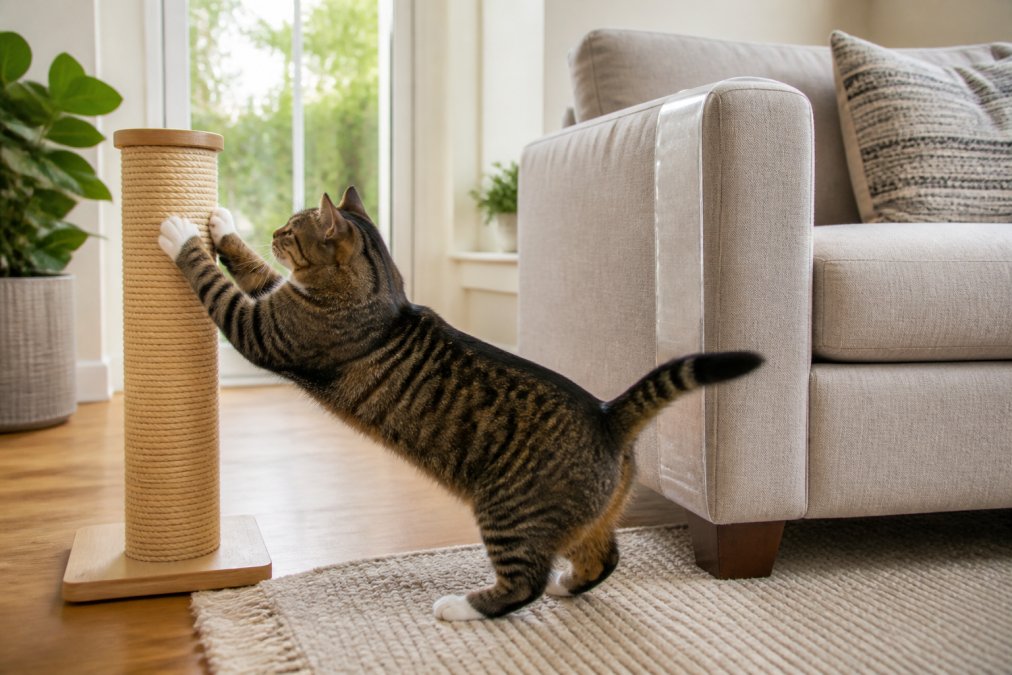
Adhesive vs. Non-Adhesive Options
| Option | Best For | Drawback |
|---|---|---|
| Adhesive guards | Small, specific hot spots | Can leave residue on fabric |
| Deterrent tape | Testing a spot before committing | Needs frequent replacement |
| Throw blankets | Quick, low-cost coverage | Slips and bunches easily |
| Fitted protectors | Full couch protection | Higher upfront cost |
Adhesive products suit a single chair arm. Full-coverage protectors suit a whole sofa. Most homes need both.
How to Train a Cat to Use a Scratching Post
Training a cat to use a scratching post takes patience and consistency, not force. Most cats adapt within a few weeks when the setup is right.
Follow these steps:
- Pick a sturdy post that will not wobble.
- Place it near the furniture your cat already scratches.
- Rub catnip spray on the post to draw interest.
- Gently guide your cat's paws to the post after a nap.
- Praise and reward every use with a treat.
- Never punish scratching on furniture. Redirect instead.
- Trim nails every two weeks to reduce damage.
Placement, Positive Reinforcement, and Consistency
Placement is the biggest factor. A post in a quiet corner gets ignored. A post beside the couch gets used.
Best Cat-Proof Furniture Covers for Upholstery Protection
The best cat-proof furniture covers use tight-weave fabric that claws cannot catch. Loose weaves snag and pull. Dense fabric resists damage.
Fabric Compatibility Matrix
| Underlying upholstery | What claws do to it | Cover that works | Cover that fails |
|---|---|---|---|
| Leather / faux leather | Punctures and surface scratches; oils from paws dull the finish | Smooth, backed microfiber or suede-faced protector with a non-slip backing | Loose knits and sherpa, they slide, trap heat, and can transfer dye |
| Linen / cotton | Loose weave lets claws hook and pull a single thread into a run | Tight-weave (high thread count) quilted protector with bound edges | Open-weave throws and crochet blankets, claws catch immediately |
| Velvet / chenille | Deep pile traps fur and snags into visible tracks | Dense, low-pile cover with a smooth face; avoid anything with loops | Loop-knit or waffle-weave covers, loops catch and pull |
| Microfiber / performance weave | Resists snags but holds odor and static | Washable tight-weave cover with a moisture barrier | Unbacked fleece, pills and holds smell |
| Recliners / lift chairs | Claws hit the footrest and arm seams where fabric flexes | Stretch panel cover with reinforced seams at hinge points | Rigid fitted covers, they pop off when the chair moves |
Why Weave and Pile Matter More Than Brand
A claw catches when it can hook a loop or a loose thread. Tight, flat weaves give the claw nothing to grab, so the paw slides off. Deep piles and loop knits give the claw a handle, which is why velvet and chenille show damage fastest even though they feel luxurious.
Fit, Seams, and the Spots Cats Target
- Reinforced seams at arms, cushion edges, and the front skirt.
- Elastic or strap anchors so the cover stays put during a stretch.
- Machine-washable fabric so fur and odor do not build up between washes.
Magic Fabric™ makes furniture covers with patented fabric technology that absorbs liquids fast and locks in odors, including urine. The material is PFAS-free, machine washable, and holds up to daily use.
DIY vs. Commercial Protection: Cost, Durability, and Residue
DIY options cost less upfront but usually need replacing sooner. Commercial protectors cost more and last longer. The real decision is not price, it is how much residue risk you are willing to take on your upholstery.
Common DIY approaches include:
- Double-sided tape on furniture arms
- Throw blankets over cushions
- Aluminum foil on scratch-prone spots
- Homemade vinegar sprays as a repellent
DIY vs. Commercial: A Side-by-Side
| Factor | DIY (tape, foil, blankets) | Commercial protectors |
|---|---|---|
| Upfront cost | Lowest | Higher |
| Lifespan | Days to weeks | Months to years with washing |
| Residue risk | High with adhesive tape | Low if you follow removal steps |
| Aesthetic | Visible and improvised | Designed to blend with furniture |
| Behavior change | None, it only blocks | None on its own; pair with a post |
A common pattern is that owners start with tape, then switch to a fitted protector once they see residue or watch the tape fail. The tape is a useful test, it tells you which spots your cat targets, but it is not a long-term answer.
Removing Adhesive Residue Safely by Finish
- Finished leather and faux leather: Warm the adhesive with a hair dryer on low, peel slowly at a shallow angle, then wipe with a cloth dampened with mild soap and water. Avoid alcohol and acetone, they strip the finish.
- Cotton and linen: Peel at a low angle, then lift residue with a dab of mild dish soap on a damp cloth. Do not scrub, scrubbing fuzzes the weave.
- Velvet and chenille: Do not pull. Work the adhesive loose with your fingers and a soft brush, then blot with a barely damp cloth. Water rings velvet permanently.
- Microfiber and performance weaves: Warm, peel slowly, then wipe with mild soap and water. Microfiber releases adhesive more cleanly than velvet but holds odor if you leave residue behind.
- Wood frames and legs: Use a plastic scraper, not metal, then a cloth with mild soap. Metal tools gouge the finish.
Commercial covers sidestep the residue problem entirely because they do not rely on adhesive. That is the strongest argument for them beyond durability, you are buying the ability to remove and wash the protector without ever touching the furniture's finish.
Maintenance: Cleaning, Washing, and Upholstery Safety
Regular cleaning keeps protectors working and extends their life. Most washable covers handle a standard machine cycle.
Here is a simple routine:
- Shake off loose fur and debris weekly.
- Vacuum the cover with a brush attachment.
- Wash every two to four weeks, or sooner after accidents.
- Use cold water and mild detergent.
- Air dry or tumble on low heat.
Conclusion
Protecting furniture from cat claws is not about stopping your cat. It is about giving them a better target and covering what matters.
Frequently Asked Questions
What is the best way to keep cats from clawing furniture?
Combine management and training. Place a sturdy scratching post near the furniture your cat targets, use a deterrent like double-sided tape or a vinyl guard on the couch, and reward your cat with treats or praise whenever it uses the post. Trim nails every 10 to 14 days to blunt damage. Consistency matters more than any single product; most cats adjust within two to four weeks when the alternative surface is more appealing.
What is the best furniture protector to prevent cat scratches?
The best protector depends on your fabric and setup. Adhesive vinyl guards work on upholstery corners but can leave residue on delicate weaves. Thick, washable furniture covers that stay in place offer broader protection and are easy to clean. Look for covers with a secure fit, odor resistance, and materials tested for durability. For leather or microfiber, test any adhesive product on a hidden area first.
How do I redirect my cat's scratching behavior?
Redirect by making the current target less appealing and the alternative more attractive. Cover the scratched area with a deterrent, then place a scratching post or pad right next to it. Rub catnip or use a pheromone spray on the new surface. When your cat scratches the post, immediately offer a treat or praise. Never punish; punishment increases anxiety and can worsen scratching. Stay consistent for at least three weeks.
Are furniture covers effective against cat claws?
Yes, when they fit well and stay in place. Covers create a physical barrier between claws and upholstery, preventing snags and punctures. Washable covers also manage fur, dander, and accident odors. Effectiveness depends on fit: loose covers bunch up and can be pulled aside. Look for covers with secure straps or non-slip backing. For best results, pair covers with a scratching post and regular nail trims.