

How to Clean Pet Hair from Upholstery: 2026 Guide
Table of Contents
- Why Pet Hair Clings to Upholstery (and Why It Matters)
- What You'll Need Before You Start
- Step-by-Step: How to Clean Pet Hair from Upholstery
- Choosing the Best Pet Hair Remover for Couch Fabric
- How to Keep Dog Hair Off Furniture Long-Term
- Fabric-Specific Safety Warnings and Allergen Management
- Frequently Asked Questions
Last Updated: September 17, 2026
Why Pet Hair Clings to Upholstery (and Why It Matters)
Pet hair removal from upholstery is difficult because of static electricity, not because vacuums are weak. As your pet sheds, each hair picks up a static charge that makes it cling to fabric weave like a magnet to steel. Dander, the microscopic skin flakes attached to those hairs, carries allergens that settle deep into the textile, which is why surface vacuuming alone rarely solves the problem.
What You'll Need Before You Start
Gather your tools before you touch the couch. Stopping mid-clean to hunt for a crevice tool breaks your rhythm and leaves half-loosened hair to settle back into the fabric.
- Vacuum with an upholstery attachment and crevice tool
- Rubber gloves (dishwashing style with textured rubber bristles)
- Lint roller or wide adhesive tape
- Squeegee with a clean rubber edge
- Spray bottle with water and a small amount of fabric softener
- Microfiber cloths
- Upholstery brush with soft bristles
Step-by-Step: How to Clean Pet Hair from Upholstery
The full process takes about 20 to 30 minutes per couch and works on most standard fabrics. Work top to bottom, cushion by cushion, so loosened hair falls onto sections you haven't cleaned yet rather than back onto finished ones.
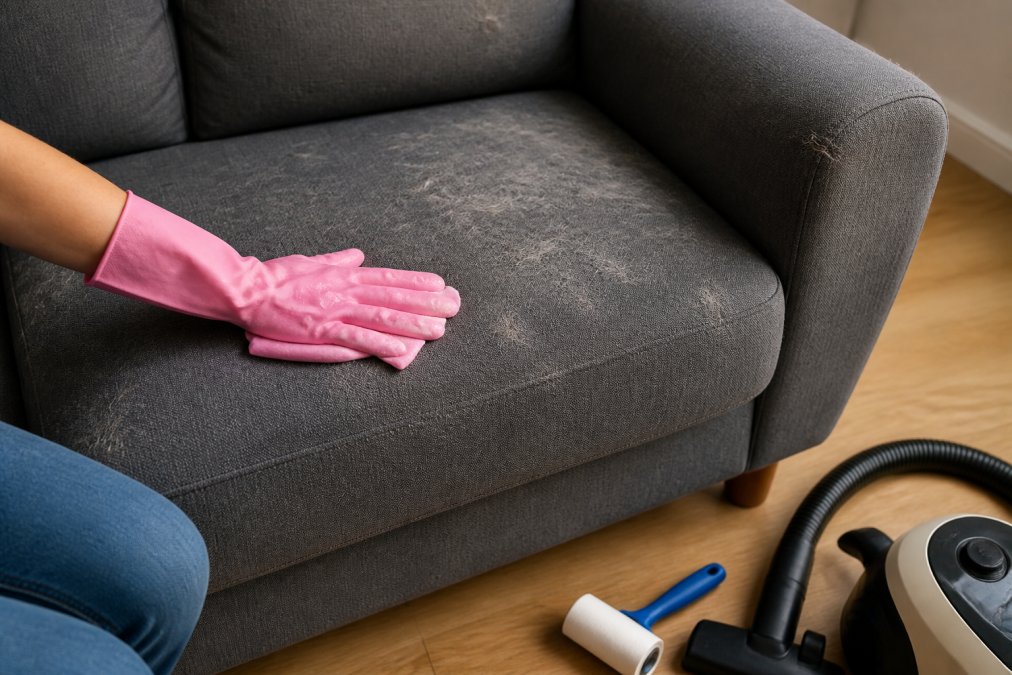
Step 1: Vacuum with an Upholstery Attachment
Run the upholstery attachment slowly across every surface, then switch to the crevice tool for seams, folds, and the gap between cushions. Suction power matters less than patience here. Fast passes skim the surface; slow passes pull hair out of the fabric weave.
Step 2: Loosen Embedded Hair with the Dampened Rubber Glove Method
Dampen a rubber glove slightly and wipe the fabric in one direction. The rubber creates friction that breaks the static charge holding embedded hair in place, and the hair rolls into clumps you can pick up by hand.
Step 3: Lift Remaining Hair with Lint Rollers and Adhesive Tapes
Press a lint roller or a strip of wide adhesive tape onto the fabric and peel it back. Adhesive grabs the short, stubborn hairs that even a rubber glove leaves behind, particularly on tight weaves.
Step 4: Finish with a Squeegee or Fabric Softener Spray
Pull a clean squeegee across the fabric in straight lines to collect any remaining hair into a single pile. For a final pass, lightly mist a water and fabric softener solution, then wipe with a microfiber cloth. The softener reduces static charge, which slows how quickly new hair clings.
Choosing the Best Pet Hair Remover for Couch Fabric
The best pet hair remover for couch fabric depends on your upholstery type, not on which tool has the loudest marketing. A rubber glove outperforms an expensive vacuum attachment on velvet; a squeegee beats both on linen. Match the tool to the textile.
| Fabric Type | Best Tool | Avoid | Why |
|---|---|---|---|
| Velvet | Dampened rubber glove | Stiff upholstery brush | Brushing crushes the pile permanently |
| Linen | Squeegee | Wet cleaning | Moisture distorts natural fibers |
| Leather | Microfiber cloth | Adhesive tape | Tape can lift the finish |
| Microfiber | Lint roller | Rubber bristles | Bristles snag the tight weave |
| Woven blends | Vacuum attachment | Excess fabric softener | Softener residue attracts new hair |
How to Keep Dog Hair Off Furniture Long-Term
Keeping dog hair off furniture is a prevention problem, not a cleaning problem. If you're only removing hair after it lands, you're doing the same job forever. The habits below cut how often you need the full four-step routine, but they work for specific reasons, not just because "consistency matters."
Attack the Source: Grooming Cadence
Shedding is continuous, but the volume is not. Most dogs shed heaviest in spring and fall coat blows, and daily brushing during those windows removes far more loose hair than the same effort in a slow-shed month. Outside peak season, two to three brushings a week is usually enough to keep ahead of it.
Break the Static Cycle
Hair clings because of static, and static builds faster on dry fabric in low humidity. Running a humidifier in winter, when indoor air is driest, measurably reduces how aggressively hair sticks to upholstery. A light mist of water and fabric softener on the fabric, the same solution from the cleaning steps, resets the charge between deep cleans.
Match Your Cleaning Frequency to Your Pet
A single short-haired dog and a double-coated breed don't need the same schedule. A reasonable starting cadence:
- Heavy shedders (Husky, German Shepherd, Labrador): vacuum pass every one to two days during coat blow, every two to three days otherwise.
- Moderate shedders (most terriers, spaniels): every three to four days.
- Light shedders (Poodle, Bichon, Schnauzer-type coats): weekly is usually sufficient.
Contain the Problem Before It Reaches the Fabric
The most effective long-term move is to give your pet a designated spot with a washable barrier. A protective cover on the seat your pet claims means hair and dander collect on a layer you can strip off and launder, instead of on upholstery you can't. Rotate two covers so one is always clean while the other washes.
Keep Tools Within Reach
A lint roller in the room your pet uses most gets used. One stored in a closet does not. The same applies to a handheld vacuum or a rubber glove kept near the couch, friction tools only work when they're accessible enough to grab during a commercial break.
Fabric-Specific Safety Warnings and Allergen Management
Most guides hand you one method and assume every couch is the same. It isn't. The wrong tool doesn't just fail to remove hair, it can permanently damage the textile. Below is a fabric-by-fabric 'do not use' list, followed by the allergen angle almost no cleaning guide addresses.
Do-Not-Use List by Fabric
Silk and silk blends. Never use a stiff upholstery brush, a rubber-bristle glove, or adhesive tape. Silk filaments snag and pull, and the damage is irreversible. Use only a vacuum on the lowest suction setting with a soft brush attachment, or a clean microfiber cloth wiped in one direction.
When you can't identify the fabric, test on the underside of a cushion or a hidden seam before touching a visible surface. If a fiber content tag is missing, assume the most delicate category and work up.
Allergen Management: The Part Hair Removal Doesn't Solve
Pet hair is the visible problem. Dander, microscopic skin flakes, plus dried saliva and urine proteins, is the one that triggers allergic reactions, and it behaves differently. Dander particles are small enough to stay airborne for hours after you disturb a cushion, so a cleaning session can actually make the air worse before it gets better.
A few practical rules follow from that:
- Wear an N95 or KN95 mask while cleaning. Disturbing upholstery resuspends settled dander, and a standard dust mask won't filter particles that small.
- Ventilate while you work, not after. Open a window or run a fan exhausting outward during the session so airborne dander leaves the room instead of resettling.
- Use a vacuum with a HEPA filter. A HEPA filter traps dander rather than blowing it back through the exhaust. A vacuum without one can redistribute allergens across the room.
- Run a standalone air purifier with a HEPA filter in the room your pet uses most. This addresses the dander that settles between cleanings, not just what you remove by hand.
- Wash covers and pet bedding in hot water (most manufacturers recommend the hottest setting the fabric allows) to denature the proteins that trigger reactions.
EPA guidance on indoor air quality and pet dander
Tool Longevity and Post-Cleaning Conditioning
Tool care. Rinse rubber gloves and squeegees after each use and let them dry fully. Fabric softener residue degrades rubber over time, and a stiff, glazed squeegee edge stops grabbing hair effectively. Store adhesive rollers away from heat so the tape doesn't lose tack.
Frequently Asked Questions
What do detailers use to remove pet hair from upholstery?
Professional detailers rely on a combination of tools: a vacuum with a crevice tool and upholstery attachment for surface hair, a dampened rubber glove or rubber bristles to loosen embedded hair, and a squeegee for final passes. They also use lint rollers and adhesive tape for touch-ups. The key is working in stages because no single tool removes all hair, especially hair woven into the fabric weave.
Is it safe to use a rubber glove on delicate upholstery like velvet or linen?
A dampened rubber glove is generally safe on most fabrics, but velvet and other delicate textiles require a light touch. Test on a hidden area first. For velvet, brush in one direction to avoid crushing the pile. Linen can handle slightly more friction. Avoid aggressive scrubbing on any delicate fabric, as it can cause fiber damage or pilling. A lint roller is a gentler alternative for these surfaces.
Does vinegar help loosen pet hair from fabric?
Vinegar can help loosen pet hair because its acidity breaks down some of the static charge and oils that bind hair to fabric. Mix equal parts white vinegar and water in a spray bottle, mist the upholstery lightly, wait a few minutes, then wipe with a dampened rubber glove or microfiber cloth. Always test on a hidden spot first, and avoid over-saturating the fabric, which can lead to mildew.
How can I prevent pet hair from sticking to my furniture in the first place?
Prevention starts with reducing static electricity and dander buildup. Use a fabric softener spray on upholstery, vacuum regularly with a pet-friendly vacuum, and consider a washable furniture cover designed to repel hair and lock in odors. Magic Fabric covers are machine washable and PFAS-free, which makes them a practical barrier for pet owners who want to keep hair off the sofa underneath. Grooming pets regularly also cuts shedding at the source.